Are spend caps bullish?
By Drew Bredvick··5 min read
Yes. Companies setting spend caps mean that a few power users were using so much AI that it was blowing through their annual commitment at faster than expected rates.
Uber is putting a $1,500 monthly cap on token spend per employee, per AI coding tool.
After blowing through their experimental budget, they decided to commit to a consistent $1,500 per month per user.
Power users found the expensive path
As a leader, your job is to get your whole team leaning into productivity improvements. If all the token spend is coming from a few people, the gains are concentrated in a corner of the org.
The Cursor Developer Habits Report chart is the thing to stare at:
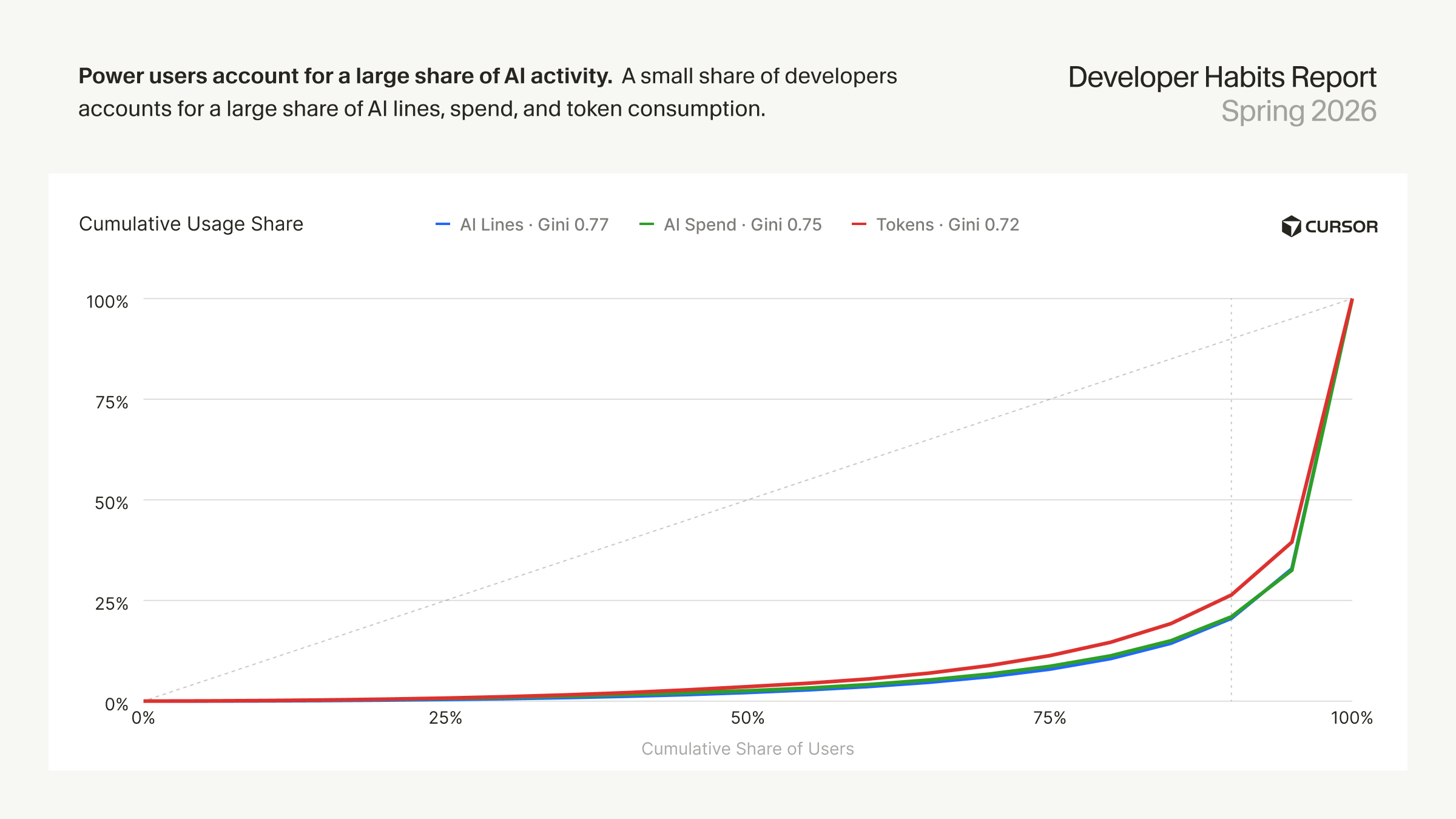
AI usage clusters hard at the top. The most aggressive power users are not 20% ahead of everyone else. Cursor says p99 developers produce 46x more AI lines per day than the median active user.
Caps save some tokens for the laggards. They also force power users to explain when blowing past the cap is worth it.
Bullish. The cap says usage is already intense enough to ration, and it gives managers a reason to get the rest of the org moving.
$1,500 is a new seat-price anchor
Anyone who works in SaaS sales is currently saying: "they get away with charging $1,500 per seat???"
Most SaaS charges something like $20 to $100 per user per month, so this sweet, sweet 15x markup seems like a dream.
Aaron Levie from Box makes this exact point. This is TAM expanding.
That matters because public markets are memetic. Buyers want to copy what other successful customers have already approved. No CFO wants to be the first person explaining a weird new budget line to the board. They are much happier saying, "Uber has a $1,500 cap per user per tool, and we are putting ours at $800 with approval for exceptions."
So if this devtool ratio expands to other roles and departments, the spend can get very large very fast. Probably.
Bullish. $1,500 per month per user is a new anchor for what AI software can cost inside a large company.
Benchmark
This also creates a benchmark that other CFOs of publicly traded companies can call out as "normal" limits. Public markets are very memetic, and buyers want to copy what other successful customers have done.
Anthropic, OpenAI, Cursor, and every internal AI platform team can point at customers with spend caps and say, "here's how you guarantee a return and limit downside," which every enterprise buyer, procurement team, and CFO will jump with joy when they hear.
This is a tailwind for AI spend. Lots of firms have not reached this level of AI spend yet, and now they have an easy path to justifying that much spend with the board.
Part of the game of VC is having a plan for how you're going to grow the company. Leverage from AI is an answer investors are sympathetic to, so expect this to continue.
Bullish. Once a public company makes the number feel normal, everyone else gets an easier board-level justification.
Systems beat everyone vibe coding their own agents
Systems are more efficient than everyone vibe coding their own agents.
Imagine an agent that watches Slack channels and tells you when something needs your attention. Useful, right?
Now imagine every employee builds their own version. Same company. Same Slack workspace. Same channels. Same check running again and again.
Some quick math, using Opus 4.8 base input pricing at $5 per million tokens:
| Pattern | Checks per day | Input tokens per day | Opus 4.8 input cost |
|---|---|---|---|
| 100 people each watch 30 channels every 5 minutes | 864,000 | 864M | $4,320/day |
| One shared system watches 200 channels every 5 minutes | 57,600 | 57.6M | $288/day |
Same basic job. About 15x less waste, or $120,960 per month before output tokens, tools, caching, or batch discounts.
This is where I expect spend to move. The random acts of AI get squeezed. The shared systems get funded.
Systems that power the whole org are much more efficient than a pile of one-off agents.
Mixed. Bearish for random acts of AI. Bullish for shared internal systems that actually run the company.
Slop isn't bullish
Some of your highest-consuming power users are slop cannons.
Slop is negative ROI.
Crappy output gives every doubter the ammo they need to say "AI is bad." And sometimes they are right.
A recent paper on token consumption in agentic coding tasks found that runs on the same task can differ by up to 30x in total tokens, and higher token usage does not automatically translate into higher accuracy.
The cap is how companies start sorting useful AI spend from expensive slop.
Bearish for slop. Bullish for the category if the spend moves toward output that pays back.
Add it up
A few years ago, no CFO cared about token spend.
Now companies are creating dashboards, setting monthly limits, asking for ROI, and building exception paths for power users.
That is how a new software category grows up. First it gets snuck into the workflow. Then it gets expensive. Then finance asks for controls. Then procurement turns it into a budget line.
- Power-user demand is bullish.
- $1,500 per user per month as a seat-price anchor is bullish.
- A public-company benchmark for CFOs is bullish.
- Systems replacing random acts of AI is bearish for waste, but bullish for actual internal operations.
- Slop getting squeezed is bearish for lazy AI spend, but bullish for the spend that survives.
My final take: spend caps are bullish because they move AI from exploratory budget to run-rate budget. Exploration tolerates weird spikes. Run-rate budget needs owners, limits, exception paths, and a story finance can defend.
Continue reading
A few useful places to go next.

The newsletter
Don’t miss the next one.
Field notes on GTM engineering and the craft of shipping software in the AI era — straight to your inbox.
No spam. Unsubscribe anytime.


